Let's build a small sprite atlas CLI in Odin and use it to compare six
rectangle-packing algorithms on the same folder of PNGs. Given loose sprites
and a width limit, the tool packs them into one RGBA8 texture and writes each
sprite's name and rectangle as JSON or a Godot 4 SpriteFrames resource.
Odin fits this kind of data-oriented tool well: the packers operate on
plain slices of sizes and rectangles, and we only touch pixel buffers once
every sprite has coordinates. Odin's core library covers the rest without
third-party packages: core:flags
parses command-line flags, core:image/png
decodes and encodes PNGs, and core:encoding/json
serializes the layout struct.
Install Odin (installation instructions)
and check your setup with odin version. Every example below targets
dev-2026-11a.
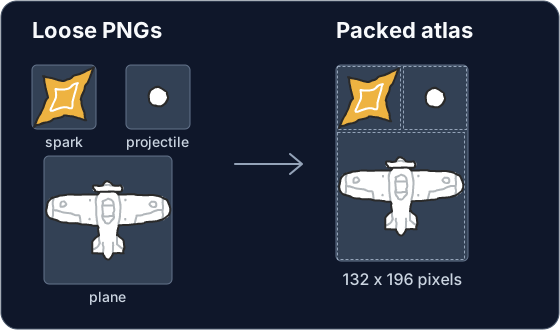
From loose PNGs to one texture
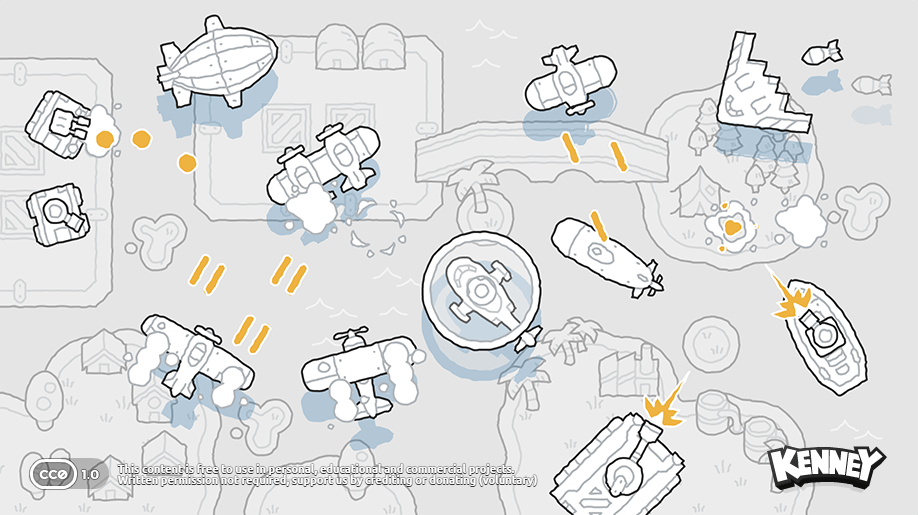
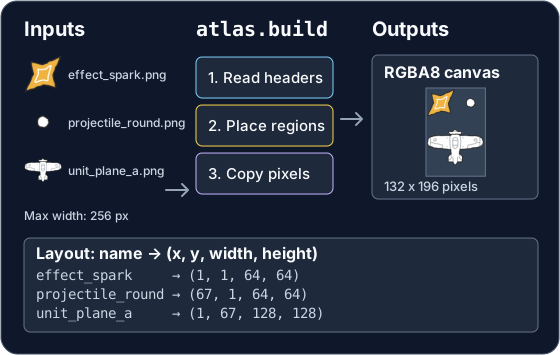
Take three CC0 sprites from Kenney's Scribble Planes
pack: effect_spark.png, projectile_round.png, and unit_plane_a.png.
Packing them with a 1-pixel transparent gutter on every side produces a
132 x 196 PNG where unit_plane_a lands at (1, 67). Those coordinates
describe its region inside the atlas, not its position on screen; a game reads
that rectangle once and draws the sprite wherever it wants.
Set up the project
Create a sprite-atlas directory, open a terminal there, and run every
command from that root, even when building a package in a subdirectory.
The project ZIP includes the
finished CLI source and Kenney's Scribble Planes pack. To run the finished
tool, extract everything into sprite-atlas/ and skip to
Run it end to end.
If you're coding along, copy just the sprites/ folder from the ZIP into
your empty project. You should now have sprites/PNG/Default/unit_plane_a.png
and sprites/License.txt. Create build/ for the output; we'll add the
source files one at a time.
Here's the layout we'll use, leaving out files we won't need
(Large* matches the 2x sprite folder without renaming it):
sprite-atlas/
  atlas/
    build.odin
    pack.odin
    pack_test.odin
    strategies.odin
    grids.odin
  cmd/
    main.odin
    stages.odin
    inspect_sprite/
      main.odin
  exporters/
    export.odin
    extract.odin
  sprites/
    License.txt
    PNG/
      Default/
      Large*/
  build/
In Odin, each directory of .odin files forms a package. Our first
package answers one question: how big is unit_plane_a.png?
Start by reading one PNG
Create cmd/inspect_sprite/main.odin. Placement only needs dimensions, so
pass {.return_header} to png.load to read the PNG header without decoding
pixel data:
package main

import "core:flags"
import "core:fmt"
import "core:image/png"
import "core:os"

Options :: struct {
    path: string `args:"pos=0,required" usage:"Input PNG path."`,
}

main :: proc() {
    options: Options
    flags.parse_or_exit(&options, os.args, .Unix)

    header, err := png.load(options.path, {.return_header})
    if err != nil {
        fmt.eprintln("reading PNG:", err)
        os.exit(1)
    }
    defer png.destroy(header)

    fmt.printf("%d x %d\n", header.width, header.height)
}
From the project root, compile and run the cmd/inspect_sprite package with
odin run:
odin run cmd/inspect_sprite -- sprites/PNG/Default/unit_plane_a.png
(out)128 x 128
Everything after -- goes to the compiled program rather than odin. Here
that's sprites/PNG/Default/unit_plane_a.png, resolved from the project root,
which the pos=0,required tag binds to options.path.
odin run deletes its temporary binary when the program exits. Running
odin build cmd/inspect_sprite compiles without executing and writes
inspect_sprite (inspect_sprite.exe on Windows) into the current working
directory rather than cmd/inspect_sprite/. For the main CLI, we'll pass
-out:build/sprite-atlas to name the binary explicitly and keep it inside
build/.
Next, create cmd/main.odin for the packer CLI. Its first positional argument
selects a subcommand validated against the Command enum. Because each
subcommand owns different flags (pack takes a width limit and output
directory, while export reads a directory produced by pack), main parses
only the subcommand name first and delegates the remaining arguments to run.
Leave run as a stub for now:
package main

import "core:flags"
import "core:fmt"
import "core:os"

Command :: enum {
    pack,
    export,
    gen,
    extract,
}

Command_Options :: struct {
    command: Command `args:"pos=0,required" usage:"pack, export, gen, or extract."`,
}

main :: proc() {
    // Parse only the command first; each command owns its own options.
    head_len := min(len(os.args), 2)
    if len(os.args) > 2 && (os.args[1] == "--command" || os.args[1] == "-command" || os.args[1] == "--") {
        head_len = 3
    }

    options: Command_Options
    flags.parse_or_exit(&options, os.args[:head_len], .Unix)
    sub_args := make([]string, len(os.args) - head_len + 1, context.temp_allocator)
    copy(sub_args[1:], os.args[head_len:])
    sub_args[0] = fmt.tprint(options.command)
    if message := run(options.command, sub_args); message != "" {
        fmt.eprintfln("sprite-atlas: %s", message)
        os.exit(1)
    }
}

run :: proc(command: Command, args: []string) -> string {
    panic("not implemented")
}
Help and subcommand validation already work before run is implemented:
odin run cmd -- --help
Passing an unknown subcommand exits with a core:flags error as well. Now we
can set the CLI aside and build the rectangle packers without opening a single
image.
Pack sizes, not images
Create atlas/pack.odin for the atlas package. Each placement procedure
takes a slice of Size values and fills a caller-allocated slice of Rect
values, with no file paths, pixel buffers, or engine types involved.
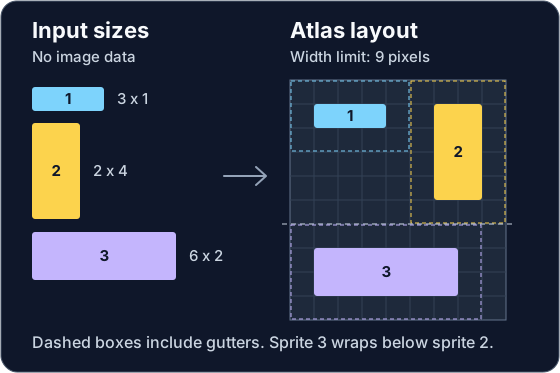
Our baseline Shelf packer starts a row at (0, 0) and pads every sprite
with a 1-pixel gutter on all four sides. When the next padded width exceeds
max_width, it wraps onto a new shelf below the tallest padded sprite in the
current row; if that row would exceed max_height, packing fails.
Placement cost for n sprites: O(n) time, O(1) extra space.
The diagram and test below trace three small rectangles inside a 9-pixel-wide limit. Once gutters are counted, the first two fill the top shelf completely, forcing the third onto a new shelf below the taller second rectangle rather than into the gap beneath the first.
package atlas

Max_Size :: 4096
Gutter :: 1 // Transparent pixels on each side of every sprite.

Size :: struct {
    width, height: int,
}

Rect :: struct {
    x, y, width, height: int,
}

Pack_Error :: enum {
    None,
    Bad_Arguments,
    Sprite_Too_Large,
    Atlas_Full,
}

// Check before adding gutters so even an oversized input can't overflow.
check_sizes :: proc(sizes: []Size, regions: []Rect, max_width, max_height: int) -> (Pack_Error, int) {
    if len(sizes) == 0 || len(sizes) != len(regions) ||
       max_width < 1 || max_width > Max_Size || max_height < 1 || max_height > Max_Size {
        return .Bad_Arguments, -1
    }
    for size, i in sizes {
        if size.width < 1 || size.height < 1 ||
           size.width > max_width - 2*Gutter || size.height > max_height - 2*Gutter {
            return .Sprite_Too_Large, i
        }
    }
    return .None, -1
}

// Pack in the caller's order. Regions are valid only on success.
pack_shelves :: proc(sizes: []Size, regions: []Rect, max_width, max_height: int) -> (used: Size, err: Pack_Error, index: int) {
    if e, i := check_sizes(sizes, regions, max_width, max_height); e != .None { return {}, e, i }

    x, y, shelf_height := 0, 0, 0
    for size, i in sizes {
        w, h := size.width + 2*Gutter, size.height + 2*Gutter
        if x + w > max_width {
            y += shelf_height
            x, shelf_height = 0, 0
        }
        if y + h > max_height {
            return {}, .Atlas_Full, i
        }

        regions[i] = {x + Gutter, y + Gutter, size.width, size.height}
        x += w
        shelf_height = max(shelf_height, h)
        used.width = max(used.width, x)
    }
    used.height = y + shelf_height
    return used, .None, -1
}
Watch how the cursor and output rectangle differ: x advances by the padded
width w, while regions[i] stores (x + Gutter, y + Gutter) with the
unpadded sprite dimensions so draw calls never sample the gutter.
Shelves leave unused space beneath shorter sprites on a row, but the arithmetic
is easy to verify by hand. Put the diagram's layout and three failure cases
into atlas/pack_test.odin; odin test discovers any procedure marked
@(test):
package atlas

import "core:testing"

@(test)
shelves_wrap_at_the_tallest_item :: proc(t: ^testing.T) {
    sizes := []Size{{3, 1}, {2, 4}, {6, 2}}
    regions: [3]Rect
    used, err, _ := pack_shelves(sizes, regions[:], 9, 10)
    testing.expect_value(t, err, Pack_Error.None)
    testing.expect_value(t, used, Size{9, 10})
    testing.expect_value(t, regions, [3]Rect{{1, 1, 3, 1}, {6, 1, 2, 4}, {1, 7, 6, 2}})
}

@(test)
rejects_invalid_or_unplaceable_sprites :: proc(t: ^testing.T) {
    regions: [2]Rect
    _, empty_err, _ := pack_shelves(nil, nil, 8, 8)
    testing.expect_value(t, empty_err, Pack_Error.Bad_Arguments)
    _, err, index := pack_shelves({{7, 1}}, regions[:1], 8, 8)
    testing.expect_value(t, err, Pack_Error.Sprite_Too_Large)
    testing.expect_value(t, index, 0)
    _, err, index = pack_shelves({{6, 4}, {6, 4}}, regions[:], 8, 8)
    testing.expect_value(t, err, Pack_Error.Atlas_Full)
    testing.expect_value(t, index, 1)
}
Run the package tests from the project root (your timing will vary):
odin test atlas
(out)Finished 2 tests in 12.837866ms. All tests were successful.
Copy rows into a texture
Once every sprite has a target rectangle, we can copy pixels into the atlas buffer. Within any single row, pixels are contiguous in both images, but the row stride changes: 3 pixels per row in the sprite below versus 8 in the atlas.
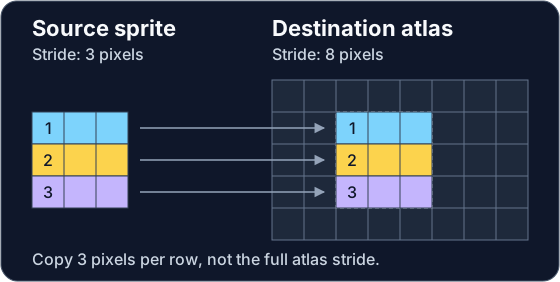
Append blit_rgba to atlas/pack.odin. Source rows advance by region.width,
destination rows advance by stride_pixels (the atlas width), and multiplying
by 4 converts pixel counts into RGBA8 byte offsets:
// Copy tightly packed RGBA8 rows. The caller supplies an in-bounds region
// matching the source dimensions and a destination of whole rows.
blit_rgba :: proc(dst, src: []byte, stride_pixels: int, region: Rect) {
    row_bytes := region.width * 4
    for row in 0..<region.height {
        from := row * row_bytes
        to := ((region.y + row) * stride_pixels + region.x) * 4
        copy(dst[to:to + row_bytes], src[from:from + row_bytes])
    }
}
Packing copies raw RGBA8 bytes without alpha blending. Semitransparent wing
edges in unit_plane_a.png keep their exact color and alpha values in the
atlas, leaving compositing to the renderer when the sprite is drawn over a
scene background.
Gutters come for free from zero initialization: a fresh canvas buffer starts
filled with (0, 0, 0, 0) (transparent black), and each copy stops at the
sprite's edge, so surrounding gutter pixels remain untouched.
Append a test to atlas/pack_test.odin with one opaque pixel (alpha = 255)
and one semitransparent pixel (alpha = 127) to confirm that blit_rgba
preserves straight RGBA values and leaves the 1-pixel border zeroed:
@(test)
blit_preserves_rgba_and_leaves_gutters_clear :: proc(t: ^testing.T) {
    dst: [3*4*4]byte
    src := []byte{7, 8, 9, 255, 10, 11, 12, 127}
    blit_rgba(dst[:], src, 4, {1, 1, 1, 2})
    expected: [3*4*4]byte = {20 = 7, 21 = 8, 22 = 9, 23 = 255, 36 = 10, 37 = 11, 38 = 12, 39 = 127}
    testing.expect_value(t, dst, expected)
}
Run the suite again to include the pixel-copy test:
odin test atlas
(out)Finished 3 tests in 12.626272ms. All tests were successful.
Packing algorithms
Shelves aren't the only way to pack an atlas. Feed the same four test rectangles, labeled A through D below, into Shelf, Skyline, and MaxRects. All three place A, B, and C at identical coordinates; they diverge on D because each algorithm tracks empty space differently. Jukka Jylänki's RectangleBinPack surveys the classic variants of all three; we'll implement one compact variant of each in Odin.
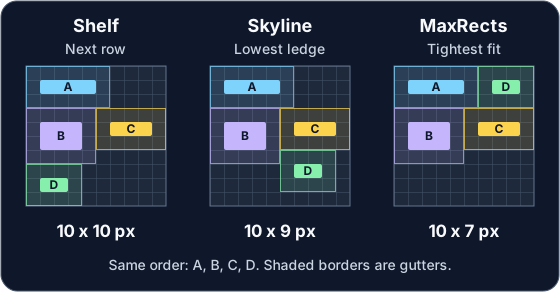
Skyline (--algorithm skyline) tracks only the highest occupied pixel in
each column. Slide the padded sprite across that profile and pick the lowest
valid y (breaking ties toward the left); testing the left edge of each flat
span is enough. Uneven heights pack tighter than on shelves, though any gap
roofed over by a wider sprite above it disappears from the profile.
Worst case: O(n W w) time, O(W) extra space (W is the atlas width
limit; w is the widest padded sprite).
Create atlas/strategies.odin:
package atlas

// Skyline bottom-left: at equal heights, keep the leftmost placement.
pack_skyline :: proc(sizes: []Size, regions: []Rect, max_width, max_height: int) -> (used: Size, err: Pack_Error, index: int) {
    if e, i := check_sizes(sizes, regions, max_width, max_height); e != .None { return {}, e, i }
    heights := make([]int, max_width)
    defer delete(heights)
    for size, i in sizes {
        w, h := size.width + 2*Gutter, size.height + 2*Gutter
        best_x, best_y := -1, max_height
        for x in 0..=max_width - w {
            // Sliding right along a flat span can't improve on its left edge.
            if x > 0 && heights[x] == heights[x - 1] { continue }
            y := 0
            for top in heights[x:x+w] { y = max(y, top) }
            if y + h <= max_height && y < best_y { best_x, best_y = x, y }
        }
        if best_x < 0 { return {}, .Atlas_Full, i }
        for &top in heights[best_x:best_x+w] { top = best_y + h }
        regions[i] = {best_x + Gutter, best_y + Gutter, size.width, size.height}
        used.width = max(used.width, best_x + w)
        used.height = max(used.height, best_y + h)
    }
    return used, .None, -1
}
MaxRects (--algorithm maxrects) maintains explicit free rectangles
instead of a 1D horizon. Using best short-side fit, it picks the free
rectangle with the smallest leftover margin on either axis, places the padded
sprite at its top-left corner, and subtracts that footprint from every
intersecting free rectangle. The leftover strips can overlap one another,
though never a placed sprite, so any strip wholly contained inside another is
pruned. That extra bookkeeping preserves the pocket beside A so D can claim it
later.
Worst case: O(n F²) time, O(F) extra space (F is the peak free-list
length, including rectangles not yet pruned).
Append split_free and pack_maxrects to atlas/strategies.odin, keeping the
caller's input order and 1-pixel gutters:
// Subtract a padded placement from one free rectangle. The leftovers may overlap.
split_free :: proc(next: ^[dynamic]Rect, f, p: Rect) {
    right, bottom := f.x + f.width, f.y + f.height
    pr, pb := p.x + p.width, p.y + p.height
    if p.x >= right || pr <= f.x || p.y >= bottom || pb <= f.y {
        append(next, f)
        return
    }
    if p.x > f.x { append(next, Rect{f.x, f.y, p.x - f.x, f.height}) }
    if pr < right { append(next, Rect{pr, f.y, right - pr, f.height}) }
    if p.y > f.y { append(next, Rect{f.x, f.y, f.width, p.y - f.y}) }
    if pb < bottom { append(next, Rect{f.x, pb, f.width, bottom - pb}) }
}

// MaxRects best short side fit. Break ties on the long side, then list order.
pack_maxrects :: proc(sizes: []Size, regions: []Rect, max_width, max_height: int) -> (used: Size, err: Pack_Error, index: int) {
    if e, i := check_sizes(sizes, regions, max_width, max_height); e != .None { return {}, e, i }
    free, next: [dynamic]Rect
    append(&free, Rect{0, 0, max_width, max_height})
    defer delete(free)
    defer delete(next)
    for size, i in sizes {
        w, h := size.width + 2*Gutter, size.height + 2*Gutter
        best, short, long := -1, Max_Size + 1, Max_Size + 1
        for f, j in free {
            dw, dh := f.width - w, f.height - h
            if dw < 0 || dh < 0 { continue }
            s, l := min(dw, dh), max(dw, dh)
            if s < short || (s == short && l < long) { best, short, long = j, s, l }
        }
        if best < 0 { return {}, .Atlas_Full, i }
        p := Rect{free[best].x, free[best].y, w, h}
        regions[i] = {p.x + Gutter, p.y + Gutter, size.width, size.height}
        used.width = max(used.width, p.x + w)
        used.height = max(used.height, p.y + h)

        clear(&next)
        for f in free { split_free(&next, f, p) }
        // Drop contained rectangles, including duplicates. Keep the other overlaps.
        for j := len(next) - 1; j >= 0; j -= 1 {
            a := next[j]
            for b, k in next {
                if j != k && a.x >= b.x && a.y >= b.y &&
                   a.x + a.width <= b.x + b.width && a.y + a.height <= b.y + b.height {
                    ordered_remove(&next, j)
                    break
                }
            }
        }
        free, next = next, free
    }
    return used, .None, -1
}
Three ways to use a grid
Next, test three grid-based packers inside a 16 x 16 limit using a second sequence of four rectangles. Including gutters, their padded sizes are A (6 x 3), B (7 x 6), C (8 x 3), and D (4 x 3), passed in that order.
Fixed grid (--algorithm grid) gives every sprite one uniform cell sized
to the widest and tallest padded inputs: 8 x 6 here, or two cells per row. A
sprite's position follows directly from its index, at the cost of charging
tiny D a full 8 x 6 cell.
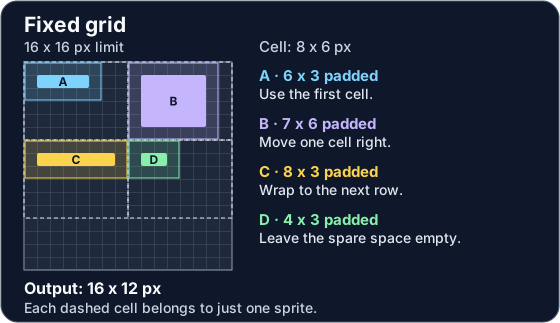
Placement cost: O(n) time, O(1) extra space.
Create atlas/grids.odin. The atlas dimensions span whole occupied cells,
while each exported Rect still wraps only the sprite inside its cell:
package atlas

import "core:math"

// One whole cell per sprite, indexed left to right and then top to bottom.
pack_fixed_grid :: proc(sizes: []Size, regions: []Rect, max_width, max_height: int) -> (used: Size, err: Pack_Error, index: int) {
    if e, i := check_sizes(sizes, regions, max_width, max_height); e != .None { return {}, e, i }
    cell: Size
    for s in sizes {
        cell.width = max(cell.width, s.width + 2*Gutter)
        cell.height = max(cell.height, s.height + 2*Gutter)
    }
    cols, rows := max_width / cell.width, max_height / cell.height
    for s, i in sizes {
        if i / cols >= rows { return {}, .Atlas_Full, i }
        x, y := (i % cols) * cell.width, (i / cols) * cell.height
        regions[i] = {x + Gutter, y + Gutter, s.width, s.height}
        used.width = max(used.width, x + cell.width)
        used.height = y + cell.height
    }
    return used, .None, -1
}
Quadtree (--algorithm quadtree) starts from a power-of-two root square
and recursively splits free squares into four equal quadrants until one matches
the smallest power of two that holds the padded sprite. A, B, and C each claim
an 8 x 8 leaf; the fourth 8 x 8 quadrant splits once more so D takes a 4 x 4
leaf. Long, narrow sprites pay a steep tax here because their longer side
dictates the square size.
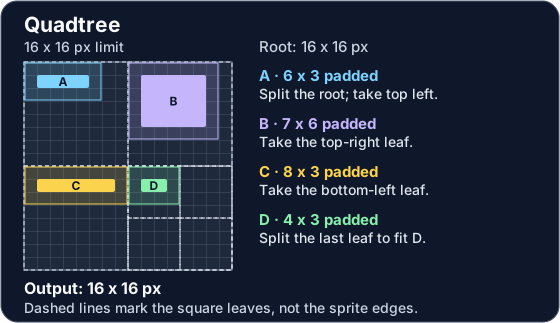
Worst case: O(n (Q + D)) time, O(Q) extra space (Q is the peak
number of free leaves; D is the maximum split depth).
Append pack_quadtree to atlas/grids.odin. Rather than building pointer
nodes, it tracks only free leaf squares: pick the smallest leaf whose top-left
need x need region fits inside (max_width, max_height), split downward into
its top-left child, and push the three unused siblings onto the free list. A
virtual power-of-two root can extend past a non-square atlas as long as every
reserved square stays within both limits:
Quad :: struct { x, y, side: int }

// Store only the free leaves. A virtual root covers even a non-square atlas.
pack_quadtree :: proc(sizes: []Size, regions: []Rect, max_width, max_height: int) -> (used: Size, err: Pack_Error, index: int) {
    if e, i := check_sizes(sizes, regions, max_width, max_height); e != .None { return {}, e, i }
    free: [dynamic]Quad
    defer delete(free)
    append(&free, Quad{0, 0, math.next_power_of_two(max(max_width, max_height))})
    for s, i in sizes {
        need := math.next_power_of_two(max(s.width, s.height) + 2*Gutter)
        best := -1
        for q, j in free {
            if q.side < need || q.x + need > max_width || q.y + need > max_height { continue }
            if best < 0 || q.side < free[best].side { best = j }
        }
        if best < 0 { return {}, .Atlas_Full, i }
        q := free[best]
        ordered_remove(&free, best)
        for q.side > need {
            q.side /= 2
            // Descend into the top-left child; keep its three siblings for later.
            append(&free, Quad{q.x + q.side, q.y, q.side})
            append(&free, Quad{q.x, q.y + q.side, q.side})
            append(&free, Quad{q.x + q.side, q.y + q.side, q.side})
        }
        regions[i] = {q.x + Gutter, q.y + Gutter, s.width, s.height}
        used.width = max(used.width, q.x + need)
        used.height = max(used.height, q.y + need)
    }
    return used, .None, -1
}
Occupancy-grid search (--algorithm occupancy) scans from the top-left
corner for every sprite, testing positions across each row and down the grid
until an entire padded footprint is clear. In the diagram, C is too wide for
the gap beneath A and drops to row 6, while narrower D backfills that gap.
Unlike Fixed grid, a single sprite spans multiple cells and reserves nothing
beyond its own gutters.
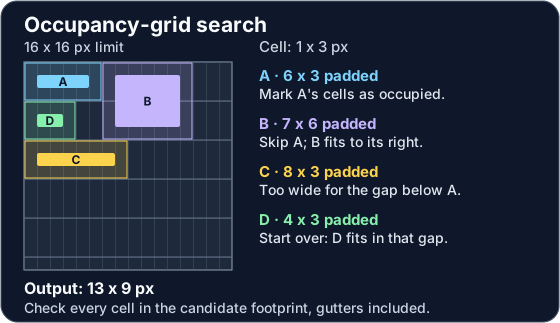
Worst case: O(n (G A + log L)) time, O(G) extra space (G is the grid's
cell count, A the largest padded sprite's cell count, and L the larger atlas limit).
Append pack_occupancy to atlas/grids.odin. Taking math.gcd across all
padded widths and heights coarsens the grid whenever inputs share a common
unit: here every padded height is a multiple of 3, collapsing three pixel
rows into one grid row. Coprime sizes fall back to 1-pixel cells and slower
scans. Storing each placed sprite's exclusive right edge in its occupied cells
lets failed checks jump straight past the blocking sprite:
// First fit, scanning rows from the top. Zero means free; a marked cell
// stores the exclusive right edge (in cells) of the sprite blocking it.
pack_occupancy :: proc(sizes: []Size, regions: []Rect, max_width, max_height: int) -> (used: Size, err: Pack_Error, index: int) {
    if e, i := check_sizes(sizes, regions, max_width, max_height); e != .None { return {}, e, i }
    cw, ch := 0, 0
    for s in sizes {
        cw = math.gcd(cw, s.width + 2*Gutter)
        ch = math.gcd(ch, s.height + 2*Gutter)
    }
    cols, rows := max_width / cw, max_height / ch
    grid := make([]u16, cols * rows) // Max_Size is 4096.
    defer delete(grid)
    sprites: for s, i in sizes {
        w, h := (s.width + 2*Gutter) / cw, (s.height + 2*Gutter) / ch
        for y in 0..=rows - h {
            search_x: for x := 0; x + w <= cols; {
                for dy in 0..<h {
                    start := (y + dy) * cols + x
                    for edge in grid[start:start+w] {
                        if edge != 0 { x = int(edge); continue search_x }
                    }
                }
                for dy in 0..<h {
                    start := (y + dy) * cols + x
                    for &edge in grid[start:start+w] { edge = u16(x + w) }
                }
                regions[i] = {x*cw + Gutter, y*ch + Gutter, s.width, s.height}
                used.width = max(used.width, (x + w)*cw)
                used.height = max(used.height, (y + h)*ch)
                continue sprites
            }
        }
        return {}, .Atlas_Full, i
    }
    return used, .None, -1
}
Append the Algorithm enum and pack_regions dispatcher to
atlas/strategies.odin. Because all six procedures share the same slice and
limit signature, the rest of the tool calls pack_regions without caring which
strategy placed the rectangles:
Algorithm :: enum { shelf, skyline, maxrects, grid, quadtree, occupancy }

pack_regions :: proc(algorithm: Algorithm, sizes: []Size, regions: []Rect, w, h: int) -> (Size, Pack_Error, int) {
    switch algorithm {
    case .shelf:    return pack_shelves(sizes, regions, w, h)
    case .skyline:  return pack_skyline(sizes, regions, w, h)
    case .maxrects: return pack_maxrects(sizes, regions, w, h)
    case .grid:     return pack_fixed_grid(sizes, regions, w, h)
    case .quadtree: return pack_quadtree(sizes, regions, w, h)
    case .occupancy: return pack_occupancy(sizes, regions, w, h)
    }
    return {}, .Bad_Arguments, -1
}
Add tests covering both sets of diagrams and a non-square boundary case to
atlas/pack_test.odin:
@(test)
strategies_place_the_fourth_sprite_differently :: proc(t: ^testing.T) {
    sizes := []Size{{4, 1}, {3, 2}, {3, 1}, {2, 1}}
    last := [3]Rect{{1, 8, 2, 1}, {6, 7, 2, 1}, {7, 1, 2, 1}}
    heights := [3]int{10, 9, 7}
    for algorithm, i in ([]Algorithm{.shelf, .skyline, .maxrects}) {
        regions: [4]Rect
        used, err, _ := pack_regions(algorithm, sizes, regions[:], 10, 16)
        testing.expect_value(t, err, Pack_Error.None)
        testing.expect_value(t, used, Size{10, heights[i]})
        testing.expect_value(t, regions, [4]Rect{{1, 1, 4, 1}, {1, 4, 3, 2}, {6, 4, 3, 1}, last[i]})
        _, full, index := pack_regions(algorithm, {{8, 8}, {1, 1}}, regions[:2], 10, 10)
        testing.expect_value(t, full, Pack_Error.Atlas_Full)
        testing.expect_value(t, index, 1)
    }
}

@(test)
grid_placements_match_the_diagrams :: proc(t: ^testing.T) {
    sizes := []Size{{4, 1}, {5, 4}, {6, 1}, {2, 1}}
    for a in ([]Algorithm{.grid, .quadtree, .occupancy}) {
        rs: [4]Rect
        used, err, _ := pack_regions(a, sizes, rs[:], 16, 16)
        testing.expect_value(t, err, Pack_Error.None)
        #partial switch a {
        case .grid:
            testing.expect_value(t, used, Size{16, 12})
            testing.expect_value(t, rs, [4]Rect{{1, 1, 4, 1}, {9, 1, 5, 4}, {1, 7, 6, 1}, {9, 7, 2, 1}})
        case .quadtree:
            testing.expect_value(t, used, Size{16, 16})
            testing.expect_value(t, rs, [4]Rect{{1, 1, 4, 1}, {9, 1, 5, 4}, {1, 9, 6, 1}, {9, 9, 2, 1}})
        case .occupancy:
            testing.expect_value(t, used, Size{13, 9})
            testing.expect_value(t, rs, [4]Rect{{1, 1, 4, 1}, {7, 1, 5, 4}, {1, 7, 6, 1}, {1, 4, 2, 1}})
        }
    }
}

@(test)
grid_packers_respect_non_square_limits :: proc(t: ^testing.T) {
    for a in ([]Algorithm{.grid, .quadtree, .occupancy}) {
        rs: [5]Rect
        // Four padded 4 x 4 tiles fit; the fifth can't use the slivers.
        used, ok, _ := pack_regions(a, {{2, 2}, {2, 2}, {2, 2}, {2, 2}}, rs[:4], 11, 9)
        testing.expect_value(t, ok, Pack_Error.None)
        testing.expect_value(t, used, Size{8, 8})
        _, full, at := pack_regions(a, {{2, 2}, {2, 2}, {2, 2}, {2, 2}, {2, 2}}, rs[:], 11, 9)
        testing.expect_value(t, full, Pack_Error.Atlas_Full)
        testing.expect_value(t, at, 4)
        _, too_big, _ := pack_regions(a, {{10, 1}}, rs[:1], 11, 9)
        testing.expect_value(t, too_big, Pack_Error.Sprite_Too_Large)
    }
}
Run all six tests in atlas:
odin test atlas
(out)Finished 6 tests in 186.688µs. All tests were successful.
Build the packing library
Create atlas/build.odin to connect PNG loading, pack_regions, and
blit_rgba. Derive each sprite's name from its filename stem and sort inputs
alphabetically so unit_plane_a lands at the same coordinates regardless of
how the shell orders input paths. Read headers in that sorted order and run the
packer before decoding full images so oversized inputs fail fast without
allocating pixel buffers.
In the three-sprite opening example, 256 is the width limit while the placed
sprites use only 132 x 196 pixels. build allocates an RGBA8 canvas of that
exact used size and pairs it with an in-memory Layout of named rectangles.
Scratch slices inside build (inputs, sizes, regions) use make paired
with defer delete, while ownership of canvas.pixels and layout.sprites
transfers to the caller (destroy frees both). A long-running tool rebuilding
atlases in a loop could route those scratch slices through an arena allocator
and reset the arena after each build, keeping only the returned Packed bundle
outside it.
package atlas

import "core:fmt"
import "core:image"
import "core:image/png"
import "core:path/filepath"
import "core:slice"
import "core:strings"

Atlas_File :: "atlas.png"

Sprite_Entry :: struct {
    name: string,
    x, y, width, height: int,
}

Layout :: struct {
    version: int,
    image: string,
    width, height: int,
    sprites: [dynamic]Sprite_Entry,
}

Packed :: struct {
    canvas: image.Image,
    layout: Layout,
}

Input :: struct {
    name, path: string,
}

// The caller owns the pixels and entries. Sprite names borrow from paths.
build :: proc(width: int, paths: []string, algorithm: Algorithm = .shelf) -> (packed: Packed, message: string) {
    if width < 1 || width > Max_Size {
        return {}, fmt.tprintf("width must be from 1 to %d", Max_Size)
    }
    if len(paths) == 0 {
        return {}, "provide at least one input PNG"
    }

    count := len(paths)
    inputs := make([]Input, count)
    defer delete(inputs)
    for path, i in paths {
        name := filepath.stem(path)
        if !strings.equal_fold(filepath.ext(path), ".png") || !valid_name(name) {
            return {}, fmt.tprintf("expected a .png file with an ASCII letter, digit, _ or - stem: %s", path)
        }
        inputs[i] = {name, path}
    }
    slice.sort_by(inputs, proc(a, b: Input) -> bool { return a.name < b.name })
    for i in 1..<count {
        if inputs[i - 1].name == inputs[i].name {
            return {}, fmt.tprintf("duplicate sprite name: %s", inputs[i].name)
        }
    }

    // Read headers and pack first so an oversized image is rejected before decoding pixels.
    sizes := make([]Size, count)
    defer delete(sizes)
    regions := make([]Rect, count)
    defer delete(regions)
    for input, i in inputs {
        header, err := png.load(input.path, {.return_header})
        if err != nil {
            return {}, fmt.tprintf("reading %s: %v", input.path, err)
        }
        defer png.destroy(header)
        sizes[i] = {header.width, header.height}
    }
    used, err, index := pack_regions(algorithm, sizes, regions, width, Max_Size)
    if err != .None {
        if index < 0 { return {}, "invalid packing arguments" }
        return {}, fmt.tprintf("packing %s: %v (limit %d x %d, including gutters)", inputs[index].path, err, width, Max_Size)
    }

    canvas := image.Image{
        width = used.width,
        height = used.height,
        channels = 4,
        depth = 8,
        pixels = make([dynamic]byte, used.width * used.height * 4),
    }
    defer if message != "" { delete(canvas.pixels) }
    for input, i in inputs {
        sprite, decode_err := png.load(input.path, {.alpha_add_if_missing})
        if decode_err != nil {
            return {}, fmt.tprintf("decoding %s: %v", input.path, decode_err)
        }
        defer png.destroy(sprite)
        size := sizes[i]
        if sprite.width != size.width || sprite.height != size.height ||
           sprite.depth != 8 || sprite.channels != 4 ||
           len(sprite.pixels) != size.width * size.height * 4 {
            return {}, fmt.tprintf("expected RGBA8 after decoding %s (16-bit PNGs are not supported)", input.path)
        }
        blit_rgba(canvas.pixels[:], sprite.pixels[:], canvas.width, regions[i])
    }

    entries := make([dynamic]Sprite_Entry, count)
    for rect, i in regions {
        entries[i] = {inputs[i].name, rect.x, rect.y, rect.width, rect.height}
    }
    return {canvas, {1, Atlas_File, used.width, used.height, entries}}, ""
}

destroy :: proc(packed: ^Packed) {
    delete(packed.canvas.pixels)
    delete(packed.layout.sprites)
}

// Use the same sprite name in the JSON entry and the Godot animation.
valid_name :: proc(name: string) -> bool {
    if len(name) == 0 { return false }
    for c in transmute([]u8)name {
        if !(c >= 'a' && c <= 'z' || c >= 'A' && c <= 'Z' ||
             c >= '0' && c <= '9' || c == '_' || c == '-') {
            return false
        }
    }
    return true
}
Build the export library
Running packing and exporting as separate stages means saving Layout to disk.
In exporters/export.odin, core:encoding/json marshals Layout directly for
both the intermediate layout.json and the exported atlas.json manifest. On
reload, read_layout checks the schema version, image filename, atlas bounds,
sprite names, and rectangle coordinates before accepting the file.
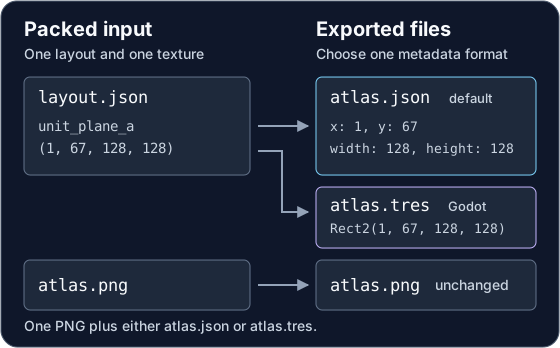
Godot 4 consumes those same coordinates through a text .tres SpriteFrames
resource: each sprite gets an AtlasTexture sub-resource pointing at the
shared atlas.png (such as Rect2(1, 67, 128, 128) for unit_plane_a) and a
single-frame animation carrying the sprite's name, without repacking or
guessing multi-frame sequences.
Each export writes atlas.png plus one metadata file: atlas.json by default
or atlas.tres with --format godot. Supporting another engine later only
means adding a Format enum value and a Writer entry in writer_for;
nothing in atlas/ needs to change.
package exporters

import "../atlas"
import "core:encoding/json"
import "core:fmt"
import "core:os"
import "core:strings"

Layout_File :: "layout.json"
Format :: enum { json, godot }

Writer :: struct {
    filename: string,
    write: proc(path: string, doc: atlas.Layout) -> string,
}

Staging :: Writer{Layout_File, write_json}
writer_for :: proc(format: Format) -> Writer {
    writers := [Format]Writer{
        .json  = {"atlas.json", write_json},
        .godot = {"atlas.tres", write_godot},
    }
    return writers[format]
}

// Both the intermediate layout and the exported manifest use the v1 schema.
write_json :: proc(path: string, doc: atlas.Layout) -> string {
    data, err := json.marshal(doc, {pretty = true, use_spaces = true, spaces = 2})
    if err != nil {
        return fmt.tprintf("encoding JSON: %v", err)
    }
    defer delete(data)
    return write_text(path, string(data))
}

// The document and its strings live in the caller's temporary allocator.
read_layout :: proc(path: string) -> (doc: atlas.Layout, message: string) {
    scratch := context.temp_allocator
    data, read_err := os.read_entire_file(path, scratch)
    if read_err != nil {
        return {}, fmt.tprintf("reading manifest %s: %v", path, read_err)
    }
    if err := json.unmarshal(data, &doc, allocator = scratch); err != nil {
        return {}, fmt.tprintf("decoding manifest: %v", err)
    }
    if doc.version != 1 {
        return {}, fmt.tprintf("unsupported atlas manifest version: %d", doc.version)
    }
    if doc.image != atlas.Atlas_File || doc.width < 1 || doc.height < 1 ||
       doc.width > atlas.Max_Size || doc.height > atlas.Max_Size || len(doc.sprites) == 0 {
        return {}, "invalid atlas image, dimensions or sprite list"
    }

    seen := make(map[string]bool, len(doc.sprites))
    defer delete(seen)
    for s in doc.sprites {
        if !atlas.valid_name(s.name) || s.name in seen {
            return {}, fmt.tprintf("invalid or duplicate sprite name: %q", s.name)
        }
        if s.x < 0 || s.y < 0 || s.width < 1 || s.height < 1 ||
           s.width > doc.width || s.height > doc.height ||
           s.x > doc.width - s.width || s.y > doc.height - s.height {
            return {}, fmt.tprintf("invalid atlas rectangle for %s", s.name)
        }
        seen[s.name] = true
    }
    return doc, ""
}

write_godot :: proc(path: string, doc: atlas.Layout) -> string {
    b := strings.builder_make()
    defer strings.builder_destroy(&b)

    fmt.sbprintf(&b, "[gd_resource type=\"SpriteFrames\" load_steps=%d format=3]\n\n", len(doc.sprites) + 2)
    fmt.sbprintf(&b, "[ext_resource type=\"Texture2D\" path=\"%s\" id=\"1\"]\n", doc.image)
    for r, i in doc.sprites {
        fmt.sbprintf(&b, "\n[sub_resource type=\"AtlasTexture\" id=\"region_%d\"]\n", i)
        fmt.sbprint(&b, "atlas = ExtResource(\"1\")\n")
        fmt.sbprintf(&b, "region = Rect2(%d, %d, %d, %d)\n", r.x, r.y, r.width, r.height)
        fmt.sbprint(&b, "filter_clip = true\n")
    }

    // One named, single-frame animation per still sprite. No guessed timing or grouping.
    fmt.sbprint(&b, "\n[resource]\nanimations = [\n")
    for input, i in doc.sprites {
        if i > 0 { fmt.sbprint(&b, ",\n") }
        fmt.sbprint(&b, "{\n\"frames\": [{\"duration\": 1.0, \"texture\": ")
        fmt.sbprintf(&b, "SubResource(\"region_%d\")", i)
        fmt.sbprint(&b, "}],\n")
        fmt.sbprintf(&b, "\"loop\": false,\n\"name\": &\"%s\",\n\"speed\": 1.0\n}", input.name)
    }
    fmt.sbprint(&b, "\n]\n")
    return write_text(path, strings.to_string(b))
}

write_text :: proc(path, data: string) -> string {
    if err := os.write_entire_file(path, data); err != nil {
        return fmt.tprintf("writing %s: %v", path, err)
    }
    return ""
}
To verify that atlas.json and atlas.png alone are enough to recover any
sprite, create exporters/extract.odin. It looks up a sprite entry by name and
reverses the row copy, reading from the atlas stride into a tight w x h
buffer so the cropped output matches the source sprite pixel for pixel:
package exporters

import "../atlas"
import "core:fmt"
import "core:image"
import "core:image/png"
import "core:path/filepath"

extract :: proc(manifest_path, name, output: string) -> string {
    doc, message := read_layout(manifest_path)
    if message != "" { return message }

    entry: atlas.Sprite_Entry
    for sprite in doc.sprites {
        if sprite.name == name {
            entry = sprite
            break
        }
    }
    if entry.name == "" {
        return fmt.tprintf("no such sprite: %s", name)
    }
    atlas_path, path_err := filepath.join({filepath.dir(manifest_path), doc.image}, context.temp_allocator)
    if path_err != nil {
        return fmt.tprintf("joining atlas path: %v", path_err)
    }
    sheet, png_err := png.load(atlas_path)
    if png_err != nil {
        return fmt.tprintf("reading atlas PNG: %v", png_err)
    }
    defer png.destroy(sheet)

    if sheet.width != doc.width || sheet.height != doc.height ||
       sheet.channels != 4 || sheet.depth != 8 {
        return "atlas PNG must be RGBA8 and match the manifest dimensions"
    }
    x, y, w, h := entry.x, entry.y, entry.width, entry.height

    crop := image.Image{
        width = w, height = h, channels = 4, depth = 8,
        pixels = make([dynamic]byte, w * h * 4),
    }
    defer delete(crop.pixels)
    for row in 0..<h {
        from := ((y + row) * sheet.width + x) * 4
        to := row * w * 4
        copy(crop.pixels[to:to + w * 4], sheet.pixels[from:from + w * 4])
    }
    if err := png.save(output, &crop); err != nil {
        return fmt.tprintf("writing sprite PNG: %v", err)
    }
    return ""
}
Wire the subcommands together
Create cmd/stages.odin to connect atlas and exporters. pack writes
atlas.png plus the staged layout.json; export_packed validates that pair,
copies atlas.png without re-encoding it, and writes the chosen metadata
format into a new directory; gen calls pack directly with the selected
format writer to skip layout.json:
package main

import "../atlas"
import "../exporters"
import "core:fmt"
import "core:image"
import "core:image/png"
import "core:os"
import "core:path/filepath"

pack :: proc(algorithm: atlas.Algorithm, width: int, out: string, paths: []string, writer: exporters.Writer) -> string {
    bundle, message := atlas.build(width, paths, algorithm)
    if message != "" { return message }
    defer atlas.destroy(&bundle)

    if err := write_bundle(out, bundle.layout, &bundle.canvas, "", writer); err != "" {
        return err
    }
    fmt.printfln("Packed %d sprites into %d x %d: %s",
                 len(bundle.layout.sprites), bundle.layout.width, bundle.layout.height, out)
    return ""
}

export_packed :: proc(packed_dir, out: string, writer: exporters.Writer) -> string {
    layout_path, layout_err := filepath.join({packed_dir, exporters.Layout_File}, context.temp_allocator)
    source_path, source_err := filepath.join({packed_dir, atlas.Atlas_File}, context.temp_allocator)
    if layout_err != nil || source_err != nil {
        return fmt.tprintf("could not construct paths in %s", packed_dir)
    }

    doc, message := exporters.read_layout(layout_path)
    if message != "" { return message }
    header, err := png.load(source_path, {.return_header})
    if err != nil { return fmt.tprintf("reading %s: %v", source_path, err) }
    defer png.destroy(header)
    if header.width != doc.width || header.height != doc.height ||
       header.channels != 4 || header.depth != 8 {
        return "packed PNG must be RGBA8 and match the layout dimensions"
    }

    if err := write_bundle(out, doc, nil, source_path, writer); err != "" {
        return err
    }
    fmt.printfln("Exported %d sprites: %s", len(doc.sprites), out)
    return ""
}

// Supply either a canvas to encode or an existing atlas PNG to copy.
write_bundle :: proc(out: string, doc: atlas.Layout, canvas: ^image.Image,
                     source_path: string, writer: exporters.Writer) -> (message: string) {
    png_path, png_err := filepath.join({out, atlas.Atlas_File}, context.temp_allocator)
    metadata_path, metadata_err := filepath.join({out, writer.filename}, context.temp_allocator)
    if png_err != nil || metadata_err != nil {
        return fmt.tprintf("could not construct paths in %s", out)
    }
    if err := os.make_directory(out); err != nil {
        return fmt.tprintf("creating new output directory %s: %v", out, err)
    }
    defer if message != "" {
        os.remove(png_path)
        os.remove(metadata_path)
        os.remove(out)
    }

    if canvas != nil {
        if err := png.save(png_path, canvas); err != nil {
            return fmt.tprintf("writing %s: %v", png_path, err)
        }
    } else if err := os.copy_file(png_path, source_path); err != nil {
        return fmt.tprintf("copying %s to %s: %v", source_path, png_path, err)
    }

    return writer.write(metadata_path, doc)
}
Return to cmd/main.odin, add import "../atlas" and import "../exporters",
and replace the run stub with the option structs and run procedure below.
Each branch hands its slice of args to core:flags. --algorithm maps
directly to atlas.Algorithm, whose zero value is .shelf. Only gen and
export accept --format, since pack always writes layout.json. Because
core:flags in dev-2026-11a cannot attach both a long flag and a short alias
to one field, every option uses its full name (such as --max-width and
--output):
Pack_Options :: struct {
    algorithm: atlas.Algorithm `usage:"Placement: shelf (default), skyline, maxrects, grid, quadtree, or occupancy."`,
    max_width: int `args:"required" usage:"Maximum atlas width in pixels, including gutters."`,
    output: string `args:"required" usage:"New output directory."`,
    overflow: [dynamic]string `usage:"Input PNG paths (at least one)."`,
}

Gen_Options :: struct {
    format: exporters.Format `usage:"Metadata: json (default) or godot."`,
    algorithm: atlas.Algorithm `usage:"Placement: shelf (default), skyline, maxrects, grid, quadtree, or occupancy."`,
    max_width: int `args:"required" usage:"Maximum atlas width in pixels, including gutters."`,
    output: string `args:"required" usage:"New output directory."`,
    overflow: [dynamic]string `usage:"Input PNG paths (at least one)."`,
}

Export_Options :: struct {
    format: exporters.Format `usage:"Metadata: json (default) or godot."`,
    packed_dir: string `args:"required" usage:"Directory produced by pack."`,
    output: string `args:"required" usage:"New output directory."`,
}

Extract_Options :: struct {
    manifest: string `args:"required" usage:"Atlas JSON manifest path."`,
    name: string `args:"required" usage:"Sprite name to extract."`,
    output: string `args:"required" usage:"Output PNG path."`,
}

run :: proc(command: Command, args: []string) -> string {
    // args[0] is the subcommand name for core:flags' usage message.
    switch command {
    case .pack:
        options: Pack_Options
        flags.parse_or_exit(&options, args, .Unix)
        defer delete(options.overflow)
        return pack(options.algorithm, options.max_width, options.output, options.overflow[:], exporters.Staging)
    case .gen:
        options: Gen_Options
        flags.parse_or_exit(&options, args, .Unix)
        defer delete(options.overflow)
        return pack(options.algorithm, options.max_width, options.output, options.overflow[:], exporters.writer_for(options.format))
    case .export:
        options: Export_Options
        flags.parse_or_exit(&options, args, .Unix)
        return export_packed(options.packed_dir, options.output, exporters.writer_for(options.format))
    case .extract:
        options: Extract_Options
        flags.parse_or_exit(&options, args, .Unix)
        return exporters.extract(options.manifest, options.name, options.output)
    }
    return ""
}
Run it end to end
From the project root, ensure build/ exists,
compile the CLI, and pack the three sprites from the opening diagram. Each
command creates only the final --output directory (its parent must already
exist) and refuses to overwrite an existing one, so pick a fresh --output
path whenever you rerun a step.
On macOS or Linux:
mkdir -p build
odin build cmd -out:build/sprite-atlas
./build/sprite-atlas pack --max-width 256 --output build/packed sprites/PNG/Default/{effect_spark,projectile_round,unit_plane_a}.png
(out)Packed 3 sprites into 132 x 196: build/packed
./build/sprite-atlas export --packed-dir build/packed --output build/exported
(out)Exported 3 sprites: build/exported
On Windows (PowerShell):
New-Item -ItemType Directory -Force build > $null
odin build cmd -out:build/sprite-atlas.exe
$sampleSprites = @('effect_spark', 'projectile_round', 'unit_plane_a') | ForEach-Object { "sprites/PNG/Default/$_.png" }
& .\build\sprite-atlas.exe pack --max-width 256 --output build/packed @sampleSprites
& .\build\sprite-atlas.exe export --packed-dir build/packed --output build/exported
build/packed/ now holds atlas.png and layout.json, and build/exported/
contains an identical atlas.png alongside atlas.json. To generate a Godot
resource from those same three sprites without rerunning pack, run export
again with --format godot and a fresh --output directory.
For the full 111-sprite sets, gen packs and exports in a single pass. Keep
Default/ and Large*/ in separate atlases: both sets reuse filenames like
unit_plane_a.png, and atlas.build rejects duplicate sprite names.
On macOS or Linux:
./build/sprite-atlas gen --max-width 1024 --output build/scribble sprites/PNG/Default/*.png
(out)Packed 111 sprites into 990 x 980: build/scribble
./build/sprite-atlas gen --max-width 2048 --output build/scribble-2x sprites/PNG/Large*/*.png
(out)Packed 111 sprites into 1950 x 1940: build/scribble-2x
On Windows, PowerShell doesn't expand wildcards for native executables, so collect the file paths explicitly first:
$defaultSprites = @(Get-ChildItem -LiteralPath 'sprites/PNG/Default' -Filter '*.png' -File | ForEach-Object { $_.FullName })
$largeSprites = @(Get-ChildItem -Path 'sprites/PNG/Large*/*.png' -File | ForEach-Object { $_.FullName })
& .\build\sprite-atlas.exe gen --max-width 1024 --output build/scribble @defaultSprites
& .\build\sprite-atlas.exe gen --max-width 2048 --output build/scribble-2x @largeSprites
--max-width is an upper bound, not a fixed canvas width: Shelf packs the
default set into 990 x 980 pixels and the 2x set into 1950 x 1940. To compare
the remaining five strategies on the default set, pass --algorithm to pack
or gen with a fresh output directory each time (export doesn't accept
--algorithm because coordinates are already fixed in layout.json):
./build/sprite-atlas pack --algorithm skyline --max-width 1024 --output build/skyline sprites/PNG/Default/*.png
(out)Packed 111 sprites into 990 x 916: build/skyline
./build/sprite-atlas pack --algorithm maxrects --max-width 1024 --output build/maxrects sprites/PNG/Default/*.png
(out)Packed 111 sprites into 990 x 916: build/maxrects
./build/sprite-atlas pack --algorithm grid --max-width 1024 --output build/grid sprites/PNG/Default/*.png
(out)Packed 111 sprites into 910 x 2080: build/grid
./build/sprite-atlas pack --algorithm quadtree --max-width 1024 --output build/quadtree sprites/PNG/Default/*.png
(out)Packed 111 sprites into 1024 x 3072: build/quadtree
./build/sprite-atlas pack --algorithm occupancy --max-width 1024 --output build/occupancy sprites/PNG/Default/*.png
(out)Packed 111 sprites into 990 x 916: build/occupancy
On Windows, substitute @defaultSprites for the glob. Skyline, MaxRects, and
Occupancy tie at 990 x 916 (64 rows shorter than Shelf), while Fixed grid
(910 x 2080) and Quadtree (1024 x 3072) pay for uniform cells and power-of-two
squares. That overhead bites harder at 2x scale: once gutters turn a 256 x 256
sprite into 258 x 258, Fixed grid allocates 258 x 258 cells and Quadtree jumps
to 512 x 512 leaves. Both hit the 4096-pixel height limit at --max-width 2048
and require --max-width 4096, whereas the other four packers fit within 2048.
When would you pick something other than MaxRects?
Aside from the deliberate 1-pixel gutters, unused atlas space still costs
memory: in an uncompressed RGBA8 texture, a transparent pixel takes the same
four bytes as a painted one. For a fixed set of mixed-size sprites, MaxRects is
a strong starting point, though its greedy per-sprite fit doesn't guarantee the
smallest width * height overall.
You can reproduce a small counterexample with pack_regions: pass four test
sprites (6 x 2, 2 x 6, 2 x 4, and 2 x 6, in that order) with
max_width = 16 and the standard 1-pixel gutters. Both MaxRects and Skyline
place the first three sprites identically. On the fourth, MaxRects picks the
tighter short-side fit beneath the third sprite for a 16 x 14 atlas, while
Skyline places it beneath the shorter first sprite and finishes at 16 x 12.
Atlas area isn't the only tradeoff to weigh:
- Shelf: When animation frames share a similar height, little space is lost
beneath shorter frames, and single-pass
O(n)placement with a row cursor and shelf height is fast enough to rerun on every asset edit. - Skyline: Tracking one height per column avoids splitting and pruning free rectangles while matching MaxRects' 990 x 916 dimensions on Scribble Planes.
- Fixed grid: For uniform tilesets (such as 16 x 16 tiles in 18 x 18 padded
cells), there is zero slack inside a cell, and a tile editor or renderer
can compute tile
ifrom its row and column without a rectangle lookup. - Quadtree: If a renderer already manages power-of-two square slots (32, 64, and 128 pixels), leaf coordinates land on aligned slot boundaries and suit runtime caches where four evicted siblings coalesce back into their parent square. This CLI only builds static atlases; it doesn't implement eviction.
- Occupancy grid: When padded sprite sizes share a coarse
gcd, scanning cells in row order is straightforward to inspect and reuses interior holes without maintaining MaxRects' free list. When sizes are coprime and cells shrink to 1 x 1 pixels, that scan becomes much less attractive.
Try it in Godot
To export all 111 default sprites directly for Godot 4 instead of JSON, pass
--format godot to gen:
./build/sprite-atlas gen --format godot --max-width 1024 --output build/godot sprites/PNG/Default/*.png
(out)Packed 111 sprites into 990 x 980: build/godot
On Windows, reuse @defaultSprites:
& .\build\sprite-atlas.exe gen --format godot --max-width 1024 --output build/godot @defaultSprites
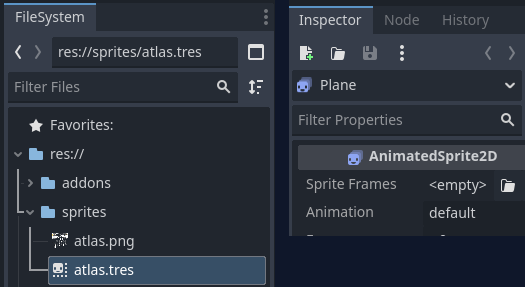
Copy atlas.png and atlas.tres from build/godot/ into the same folder in
your Godot project (res://sprites/ in the screenshots below). Once the editor
imports the PNG, both files appear in the FileSystem dock; Godot doesn't
need atlas.json.
Add an AnimatedSprite2D node (named Plane here) to a 2D scene and select it
in the scene tree. Drag atlas.tres from the FileSystem dock onto the empty
Sprite Frames property in the Inspector. Assign the .tres resource rather
than atlas.png: the resource already defines all 111 AtlasTexture regions.
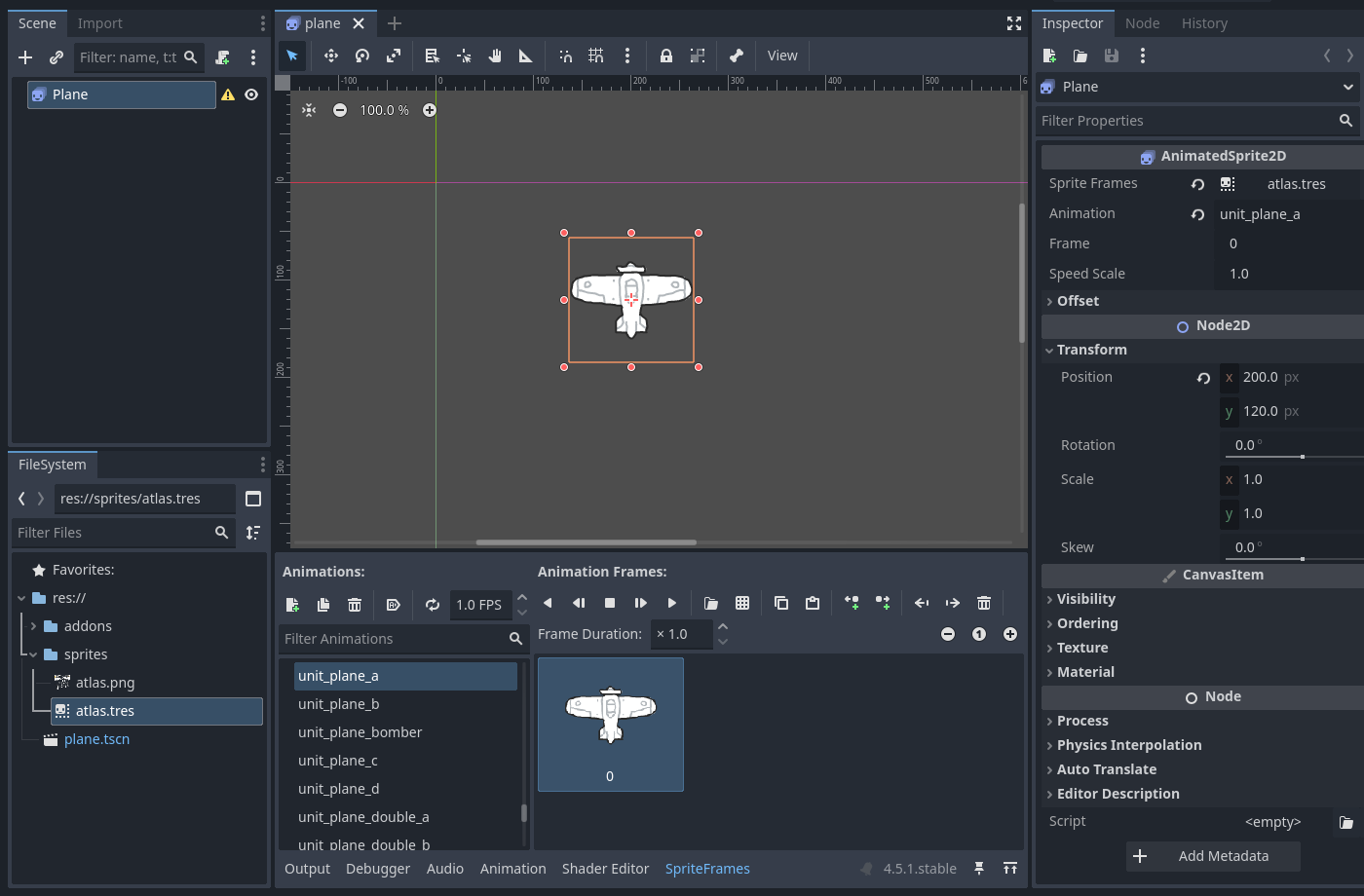
Click the assigned resource to open the SpriteFrames panel, then select
unit_plane_a under Animations. The panel shows its single frame, and the
viewport renders just the plane rather than the whole sheet. Each
AtlasTexture sets filter_clip = true, which pairs with the 1-pixel
transparent gutters to prevent neighbor bleed at the base mip level (Godot's
default Fix Alpha Border import option also fills RGB values on alpha = 0
gutter pixels to avoid dark linear-filtering fringes; if you enable mipmaps,
use nearest filtering or extrude sprite edges).
Check the JSON export
To verify the JSON export without Godot, extract unit_plane_a by name into a
standalone PNG (pick an --output path you don't mind overwriting):
On macOS or Linux:
./build/sprite-atlas extract --manifest build/scribble/atlas.json --name unit_plane_a --output build/plane.png
On Windows (PowerShell):
& .\build\sprite-atlas.exe extract --manifest build/scribble/atlas.json --name unit_plane_a --output build/plane.png
Open build/plane.png and you'll get the 128 x 128 plane back cleanly, without
a single pixel from its neighbors. Its decoded RGBA8 pixels match the original
byte for byte, though the .png file sizes differ because Kenney's source
unit_plane_a.png is palette-indexed while extract writes RGBA8.
Download the finished example
To compare your Odin code against the complete project,
download the project ZIP.
The code and tests are MIT-licensed. Kenney's Scribble Planes
is included under CC0;
you'll find the original license in sprites/License.txt.